
The 6 Stages of Disease in Ayurveda
By Françoise Barrios

The Concept of Shatkriyakala
Ayurveda, one of the oldest systems of medicine in the world, offers a unique perspective on health and disease. Unlike modern medicine, which often diagnoses a disease once the symptoms are obvious, Ayurveda sees disease as a gradual process that begins long before any visible signs appear. This concept is beautifully illustrated in the Charaka Samhita, a founding text of Ayurveda more than 2,000 years old, through Shatkriyakala – the six stages in the development of a disease.
This article aims to make this ancestral wisdom accessible so that everyone can apply it in daily life. By understanding these stages, we can act early and prevent disorders before they take hold.
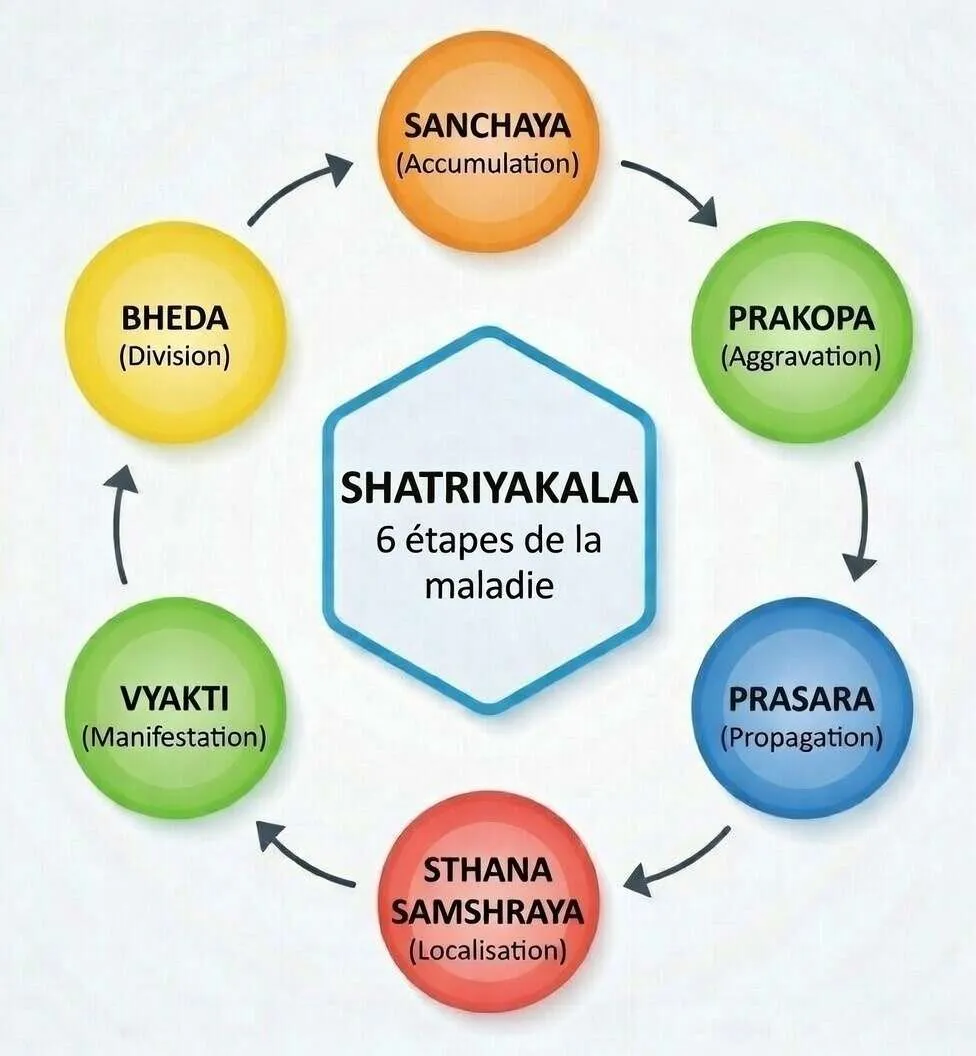
What is Shatkriyakala?
The term Shatkriyakala translates as "six periods of action" or "six stages for intervention". It describes how a disease develops from a simple imbalance of the doshas (Vata, Pitta and Kapha, the three vital energies in Ayurveda) into a chronic condition.
This framework is essential for prevention, because it helps identify the body's subtle signals and act before the disease gets worse. According to classical texts such as the Charaka Samhita and the Sushruta Samhita, these stages help not only with diagnosis but also with targeted treatment.
Imagine disease not as a sudden event, but as a gradual build-up of imperfections in body and mind, influenced by diet, lifestyle, stress and the seasons. Ayurveda invites us to listen to these "ignored signals" in order to restore balance.
The 6 Stages in Detail
Here is an overview of the six stages, knowing that each phase offers an opportunity to intervene, which makes Ayurveda a powerful tool for proactive health.
1. Sanchaya (Accumulation)
This is the quiet beginning. The doshas start to accumulate in their natural sites because of factors such as an unsuitable diet, late nights or neglected stress. You do not yet feel any obvious discomfort, but subtle signs appear: heaviness after meals, mild tiredness, or a feeling that the body is no longer as light as it used to be.
At this stage there is no declared disease, only ignored signals. Ayurveda recommends adjusting your diet and lifestyle to prevent things from escalating.
2. Prakopa (Aggravation)
If the accumulation is not corrected, the doshas become irritated and agitated. Digestion becomes unpredictable, with occasional bouts of acidity; sleep is lighter, and the mind more reactive. The body is asking for a correction, but modern medicine often considers this "normal". It is a phase in which the imbalance "heats up", and a simple intervention such as soothing herbs or more rest can reverse the trend.
3. Prasara (Spread)
The aggravated doshas no longer stay confined; they spread through the body's channels (srotas). The symptoms become confusing: pains that move around, intermittent discomfort, mood swings for no apparent reason. Nothing is fixed, but nothing is stable either.
This stage is frustrating, because the troubles come and go. Ayurveda suggests detoxifying therapies to stop this spread.
4. Sthana Samshraya (Localisation)
This is a turning point. The wandering imbalance settles in a weak point of the body – an organ, a tissue or a system that is already under strain. Patterns emerge: occasional acidity becomes a "stomach problem", stiffness turns into a joint disorder, or mental stress into chronic insomnia.
Ayurveda sees this as the last easy opportunity to reverse the process before the disease fully manifests.
5. Vyakti (Manifestation)
Now the symptoms are clear and can be diagnosed. This is usually where modern medicine steps in, with precise names for the disorders. But according to Ayurveda, the disease did not begin here; it has simply become visible. Treatment focuses on reducing the symptoms, but a holistic approach can still heal the root.
6. Bheda (Complication)
If ignored or suppressed, the disease becomes chronic. Complications arise, and one disorder leads to another. Healing is more difficult, and management becomes the main goal. At this stage, Ayurveda emphasises palliative treatments and a profound reform of lifestyle.
Why is Shatkriyakala Revolutionary?
This concept underlines that disease is a process, not an isolated event. By listening to the body early, we keep it from "shouting" later. Modern studies are even exploring its application to chronic diseases such as cancer, where early detection could make all the difference.
Ayurveda encourages us to take charge of our health by aligning our lives with natural rhythms.
For more Ayurvedic wisdom, join our online community , contact me for personalised support or to plan a panchakarma cure in India.
Namaste
Françoise Barrios